Company News
Dry Granulation Tablet Press Readiness After Roller Compaction
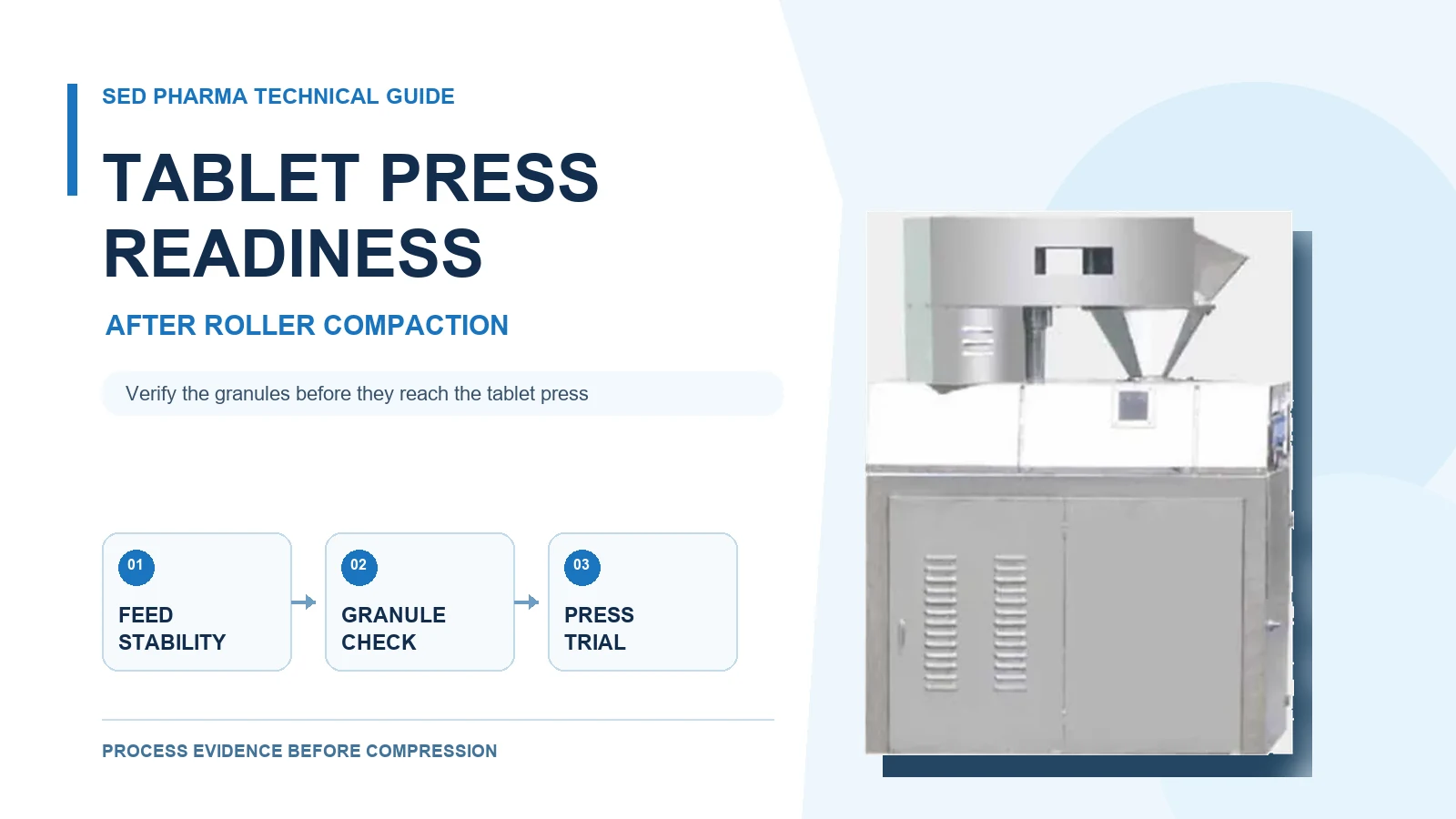
Dry granulation is ready for a tablet press only when a roller-compacted ribbon can be milled into a controlled granule population that feeds, fills, compacts, and ejects consistently. The practical readiness question is not whether a headline roller force or throughput looks adequate. Start with material behavior, define the required granule and tablet outcomes, then use a structured trial to link feed, compaction, milling, and tableting evidence. A ribbon that looks dense can still create excess fines, broad particle-size distribution, poor flow, or tablet defects downstream.
1 Define the Process Boundary Before Setting Trial Parameters
Dry granulation uses mechanical compaction rather than a liquid binder and drying step to improve handling of a blend that does not have adequate flow or compressibility in its initial state. In roller compaction, the feed system presents material to counter-rotating rolls. The resulting ribbon is then sized by a mill or screen. The output is a granule intermediate, not a finished proof that the formulation will run at the tablet press.
Keep the decision boundary clear. This article addresses roller compaction and downstream tablet-press readiness; it does not prescribe wet granulation or replace formulation development. If material is moisture- or heat-sensitive, dry granulation may be considered, but suitability still depends on the formulation, quality target, containment approach, and validated process strategy.
Define the Required Evidence
Before a machine trial, specify what has to be demonstrated: target batch scale or continuous rate, intended tablet dose and geometry, target granule particle-size distribution, acceptable fine fraction, flow behavior at the tablet press feeder, tablet strength and appearance expectations, and any containment or cleanability needs. Record the starting blend description, particle-size information where available, bulk and tapped density observations, lubricant stage, moisture sensitivity, and segregation concerns. These inputs make trial results interpretable; they are not interchangeable with a generic equipment setting.
A useful readiness statement is: “The granules must transfer through the intended handling path, feed the planned press, achieve the approved tablet attributes, and remain stable over the defined trial period.” That statement creates a measurable bridge between compaction and compression.
2 Understand the Roller Compaction Parameter System
Roll force or pressure, roll gap, roll speed, and feed-screw behavior work as a system. A change in one can alter ribbon density, thickness, porosity, and variation across the ribbon. The same setpoint can behave differently when the blend’s compressibility, particle shape, lubricant level, initial density, or feed consistency changes. Equipment displays and calculated values also differ by design, so process development should record the machine-specific parameter definition rather than assuming one supplier’s value transfers directly to another machine.
Start With Stable Feed
Unstable feed can produce alternating dense and weak ribbon zones even when roll settings remain unchanged. Observe hopper discharge, screw loading, ribbon continuity, edge quality, and density variation across a representative run. Bridging, rat-holing, segregation, or pulsing at the feeder should be investigated before raising compaction intensity. Increasing force to compensate for erratic feed can create a compacted ribbon with a misleading average density and an unstable milled output.
Set the Compaction Window Through Evidence
The trial objective is to identify a workable window, not a single “ideal” force. At too little compaction, ribbons may be fragile and break into excessive fines. At too much compaction, the ribbon can become difficult to mill consistently or create granules with poor downstream compactability. Use a controlled study that changes one justified factor at a time or follows an approved design-of-experiments plan. Compare ribbon appearance and density observations with milled particle-size distribution, flow, and tablet-press response.
Roll gap and roll speed should be reviewed with the same discipline. Gap affects ribbon thickness and compaction conditions; speed influences residence time and throughput behavior. Feed screw settings affect how material reaches the rolls. None of these parameters has a universally valid number. Establish limits through material-specific trials and document the instrument, sampling point, and test method used for every comparison.
3 Mill the Ribbon for Tablet Press Use
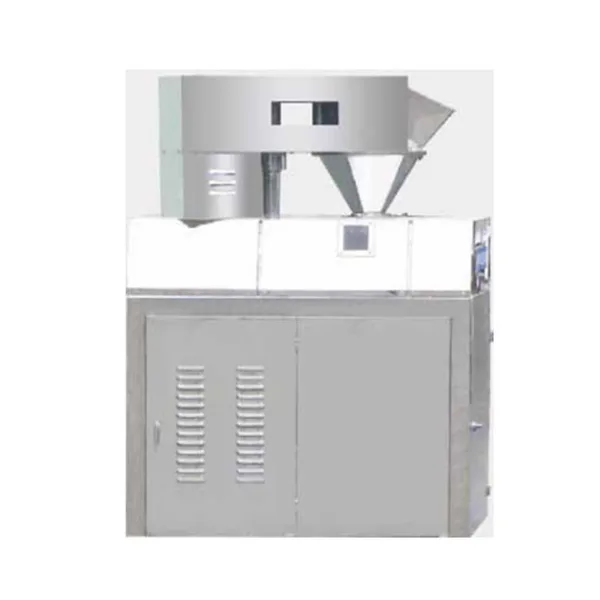
Milling converts a compacted ribbon into a granule distribution that must be suitable for transfer and die filling. The mill screen or sizing element is not a stand-alone quality control: its result depends on ribbon strength, feed rate, mill design, impeller or rotor configuration, and the material itself. A smaller opening may reduce oversize material but can also create more fines or heat exposure, depending on the system. Treat milling as a linked unit operation rather than a corrective step applied after an unstable roller-compaction process.
Use Particle Size as a Process Signal
Assess representative samples from the start, middle, and end of a trial. Compare particle-size distribution, fine fraction, density, flow, and segregation tendency with the intended press behavior. Visual appearance alone can miss changes that influence feeder performance or tablet weight control. Where a test method is part of the development or release strategy, follow the approved sampling and analytical procedure; do not substitute an informal screen check for a validated method.
| Observed condition | Possible contributing condition | Confirmation test | Next controlled action |
|---|---|---|---|
| Ribbon breaks or edge crumbles | Low or variable compaction; unstable feed; blend behavior | Trend ribbon observations and density across the run; inspect feeder behavior | Stabilize feed first, then compare an approved compaction adjustment. |
| High fine fraction after milling | Weak or nonuniform ribbon; aggressive milling; inconsistent mill feed | Compare ribbon zones, sieve results, and mill feed conditions | Review the upstream ribbon before changing screen or rotor settings. |
| Granules do not feed consistently | Broad distribution, excess fines, poor flow, segregation, or transfer effect | Check PSD, flow test, transfer path, and feeder observations | Use a representative press trial; change one material or process factor under protocol. |
| Tablets cap or laminate | Granule condition, trapped air, compression profile, tooling, or lubrication issue | Inspect defects; compare PSD and press data; confirm tooling condition | Separate press and granulation variables in an approved investigation. |
| Tablet weight varies | Feeder response, granule flow, density variation, or press setup | Trend weight with feeder and granule samples from the same period | Confirm material consistency before treating it as only a press-speed issue. |
Run the Trial in a Controlled Sequence
First, confirm that the starting blend and its handling route are representative of the intended process. Second, establish stable feeding before interpreting ribbon results. Third, collect ribbon observations and samples at defined points while recording the complete roll and feed settings. Fourth, mill the ribbons under documented conditions and compare the resulting granules with the target distribution and flow needs. Fifth, use material from a representative section of the run for tablet pressing. This order prevents a downstream change from hiding an upstream instability.
For each run, keep a comparison sheet that connects the blend lot or composition, pre-compaction handling, roll settings, ribbon observations, mill configuration, particle-size results, and press outcome. When results move in an unfavorable direction, return to the first changed condition rather than changing several settings together. That discipline is especially important when tablet strength or weight appears acceptable at one moment but the feeder behavior or fine fraction is drifting. A controlled sequence gives development and quality teams a record they can assess alongside their own risk-management and validation requirements.
4 Confirm Tablet Press Readiness With a Representative Trial
Tablet-press readiness cannot be inferred from ribbon strength alone. Run representative granules through the intended or comparable press configuration and record feeder behavior, die fill, tablet weight, compression response, ejection behavior, appearance, and the product attributes required by the development plan. The goal is to find whether the granulation supports the full compression pathway, not merely to demonstrate that a tablet can be made once at low speed.
Hold the formulation and process history together. A tablet defect may arise from granule properties, compression profile, tooling condition, lubrication, environment, or a combination. If capping, lamination, sticking, or weight variation appears, do not assign the cause to roller compaction from the symptom alone. The site guide to tablet-defect troubleshooting provides a useful symptom-to-test framework for separating these possibilities.
Check Transfer and Scale Up Assumptions
A small trial is a decision aid, not automatic proof of commercial performance. Feed geometry, roll width, material hold time, granule transfer, and tablet-press feeder design may change with scale. Define what equipment is representative, what must be re-tested, and which process or quality attributes will be compared. Follow the site change-control, risk-assessment, and validation procedures before implementing a new parameter range or equipment configuration.
5 Build a Readiness Review Brief That Produces Useful Answers
A dry granulation equipment discussion is more productive when it begins with the material and evidence rather than a model name. SED Pharma can use the process description to identify questions for a trial route or configuration review. That discussion should remain evidence-led: the appropriate roll arrangement, feed approach, milling configuration, containment, cleaning method, and downstream interface depend on the material, output target, and acceptance criteria.
Send SED Pharma your formulation and process description, blend and granule observations, target output, tablet specification, planned press and tooling details, current compaction and milling data, particle-size results, defect photos, containment objective, and cleaning requirements. Those details support a focused technical review rather than a generic equipment recommendation.
For broader process-equipment context, you can browse the full SED Pharma equipment catalog.
Conclusion
Dry granulation tablet press readiness is demonstrated when a material-specific process boundary leads to evidence that the milled granules are ready for the intended tablet press. Stable feed, controlled ribbon formation, purposeful milling, representative particle-size assessment, and a downstream compression trial provide a stronger basis than a force or capacity figure alone. Document the results, keep parameter changes controlled, and use the approved development and validation pathway to establish the final operating space.