Company News
Direct Compression in Tablet Manufacturing Powder Requirements and Press Setup

Direct compression is suitable for tablet manufacturing only when the powder blend can feed, fill, compact, eject and retain its intended quality without a granulation step. The first question is not whether a tablet press has enough force. It is whether the active ingredient and excipients form a blend with stable flow, acceptable compactability, controlled lubrication and enough uniformity at the planned dose. Start with the powder and blend behavior, then use a press trial to confirm die filling, compression response, ejection and finished-tablet properties under an approved development or validation plan.
What direct compression changes in the tablet process
In direct compression, weighed and blended ingredients move to compression without wet granulation, drying or roller compaction as an intermediate step. Removing those operations can simplify the process path, but it also removes opportunities to change particle structure, improve flow or build granule strength. The formulation therefore carries more of the burden for consistent die filling and tablet formation.
A direct-compression blend does not need to be perfect in every powder test. It does need to be understood well enough to show that the critical material attributes and the intended press conditions produce repeatable tablet quality. Flow, bulk-density behavior, particle-size distribution, moisture sensitivity, compactability, lubricant response and segregation tendency should be considered together. A powder that flows through a funnel may still fill a rotary press inconsistently, and a tablet that looks acceptable in a small trial may not show the same response at production-representative speed or dwell time. A peer-reviewed review of direct-compression development discusses the need to consider powder flow and compaction together, rather than treating press force as the sole decision variable. Read the study
This matters because a useful powder screen is not a pass or fail label for one isolated measurement. It should help the development team decide whether the blend can maintain its behavior after blending, transfer, feeder residence and compression. When those conditions are not represented, an apparently good bench result may not predict a production-relevant response. Use methods and sampling plans suitable for the formulation, and interpret the results with the intended material path and tablet quality attributes in view.
Powder requirements before choosing direct compression
Flow and die filling
The blend must enter the feed frame or feeder consistently and fill each die in a repeatable way. Cohesion, electrostatic behavior, broad particle-size distribution, moisture change, fines, segregation and changing hopper head can all alter the mass that enters a die. Watch for weight variation, rat-holing, bridging, unstable powder level, visible separation or a trend that worsens as the hopper empties. These observations do not identify one cause by themselves; they show that the material-to-feeder path needs investigation.
Compactability and elastic response
Direct compression also requires the blend to form a mechanically acceptable compact at a compression profile that the product and press can sustain. Compactability is not the same as flow. A free-flowing blend can form a weak tablet, while a compactable material can still feed poorly. During development, relate compression response to the approved product attributes such as tablet mass, thickness, breaking force or hardness, friability, disintegration and dissolution where relevant. The target values and acceptance criteria belong to the product development and quality program, not to a generic machine setting.
Lubrication and blend order
Lubricant can reduce die-wall friction and aid ejection, but it can also alter interparticle bonding and downstream tablet performance. The grade, amount, distribution and blend exposure must be evaluated for the actual formulation. Do not treat longer lubrication or more lubricant as an automatic answer to sticking, high ejection force or poor flow. If a lubricant-related change is considered, assess it through the approved formulation, change-control and validation process. Lubrication belongs in the material and process assessment because it affects both ejection behavior and the tablet compact. Review lubricant exposure together with compactability and finished-tablet observations; this is consistent with the formulation-focused direct-compression literature. Read the direct-compression review
Low dose API and segregation risk
Low-dose direct compression requires evidence that the API remains uniformly distributed through blending, transfer and feeding, not only that the blend meets an initial uniformity test. Differences in particle size, shape, density, cohesion or electrostatic response can change how the API and excipients move. A result taken before discharge can therefore be less informative than a result collected after the intended transfer and feed path has challenged the blend.
A preblend can be a useful formulation strategy when justified for the specific materials, but it is not a universal correction. Record the order of addition, blend condition and material handling sequence. Then use a sampling plan that asks whether samples remain representative across relevant blend locations, after transfer and during the planned feeder residence. Investigate any distribution change together with tablet mass and content observations; do not attribute it automatically to press settings. Direct-compression development literature treats flow, homogeneity, compactability and ejection as linked requirements. For a low-dose product, this means that material-to-equipment transfer must be part of the feasibility evidence. Read the review
Direct Compression Suitability Matrix
Use this direct compression matrix to classify a development observation as suitable to proceed, requiring verification, or better addressed through an alternative development route. It does not replace product-specific specifications or validated acceptance criteria.
| Material or process behavior | Risk if unresolved | Confirmation test | Possible path |
|---|---|---|---|
| Blend feeds and fills consistently across the intended hopper and speed range | Tablet mass variation or dose inconsistency | Trend mass, feeder behavior, powder level and blend condition during a controlled trial | Suitable to proceed with press and scale-representative verification |
| Flow is acceptable in a simple test but changes with handling, humidity or hopper level | Intermittent fill variation, bridging or segregation | Compare dynamic feed behavior with density, moisture and particle-size observations | Needs verification; adjust material handling or formulation only under the development plan |
| Blend compacts to target properties at a sustainable compression profile | Weak, friable, capped or laminated tablets | Evaluate strength, thickness, friability and defect trend across an approved compression study | Suitable to proceed if product attributes and process behavior remain controlled |
| Lubrication reduces ejection load without an adverse tablet-strength response | High ejection force, sticking or reduced interparticle bonding | Compare ejection behavior and tablet properties against the defined lubricant process | Needs verification; do not extend lubrication solely to solve a press symptom |
| Low-dose distribution or segregation remains difficult to control | Content non-uniformity despite acceptable press operation | Assess blend uniformity and segregation through the intended transfer and feeding path | Do not prioritize direct compression; evaluate granulation, preblend or formulation development |
Interpret the matrix as an evidence-routing tool. “Suitable to proceed” means the observation can move into the next planned trial or scale-representative verification; it does not establish final process validation. “Needs verification” identifies a condition that may still be manageable but requires a focused, documented study. “Do not prioritize direct compression” means that the development team should investigate another route because the unresolved risk is more likely to be formulation- or material-path-limited than a simple press adjustment can solve.
De identified direct compression suitability record
Use this documentation framework to connect material evidence to a specific press trial without presenting client identities, proprietary formulations or unverified numerical limits. The completed record should support a development decision, not replace product-specific development, quality review or process validation.
| Material and risk signal | Trial press record | Observation and failure mode | Development decision |
|---|---|---|---|
| Record relevant particle, density, moisture, flow and low-dose distribution observations. | Identify the development press, tooling, feeder configuration, blend condition and batch context. | Compare feed behavior, tablet mass, blend or tablet uniformity and visible separation. Watch for drift during hopper depletion. | Proceed only when the material path and the press response remain controlled; otherwise define the next verification study. |
| Record compactability and lubricant-response observations for the actual formulation. | Document fill depth, precompression and main-compression profile, press speed and ejection setup where applicable. | Compare thickness, strength or hardness, friability, defects and ejection trend. Watch for capping, lamination, sticking or rising ejection load. | Verify a focused formulation, tooling or process hypothesis before changing multiple variables together. |
| Record whether transfer or feeder residence changes distribution, flow or density behavior. | Describe the intended material transfer route and the production-relevant feed condition being represented. | Compare pre-transfer, post-transfer and in-process samples with the planned quality observations. Watch for evidence of segregation. | Do not prioritize direct compression when the material path cannot be shown to control the unresolved distribution risk; evaluate another development route. |
This framework makes the material-equipment connection explicit: a direct-compression route is supported only when material state, feeder behavior, compaction response, ejection and finished-tablet observations point to the same controlled decision. A single acceptable force, flow result or tablet is not sufficient evidence by itself.
Set up the press to reveal the material response
Press setup should turn material behavior into observable evidence. Start from the approved tooling, tablet geometry and development plan. Confirm the feeder type, fill-depth control, precompression arrangement, main-compression capability, ejection path, dust extraction and data collection available on the selected press. A machine can have a high nominal force and still be a poor match if the feeder, dwell, tooling, scale or control strategy does not represent the intended process.
At the beginning of a trial, establish a documented baseline rather than making multiple corrections at once. Record the blend identity and condition, batch load, hopper level approach, feeder setting, press speed, fill-depth setting, precompression and main-compression conditions where applicable, tablet mass, thickness and the selected quality observations. Change one justified factor at a time. This makes it possible to distinguish a real material response from normal sampling or machine variation.
Control rationale: Documenting material conditions, press settings and response supports a product- and process-understanding approach to control strategy. ICH Q8(R2) Pharmaceutical Development
For example, a change in feeder setting, compression profile or press speed should be evaluated against the same product observations and material condition that defined the baseline. That comparison is more informative than chasing a single force or hardness reading, because it preserves the relationship between blend behavior, die filling, compaction and ejection.
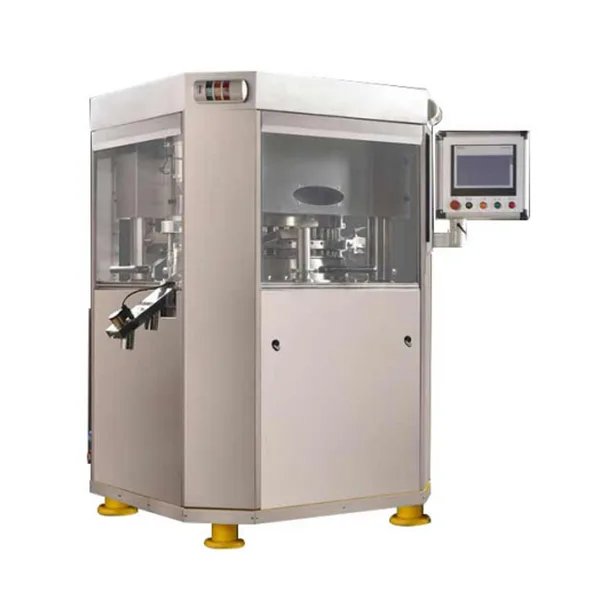
A rotary tablet press can help define the equipment discussion. Confirm the final configuration, tooling and acceptance scope with the quotation rather than treating a published specification as a process recipe.
Bridging development trials to a production rotary press
A development press and a production rotary press should be bridged through comparable material and process evidence, not by copying a speed or force setting. Establish what the development trial represented, what the production system changes and which observations must remain comparable before treating the transfer as feasible.
| Comparison area | What to establish | Evidence to review |
|---|---|---|
| Material path | Compare blend condition, transfer route, hopper head, feeder residence and any handling step that can affect density or segregation. | Feed consistency, mass trend, material condition and representative samples before and after the relevant transfer points. |
| Tooling | Record punch and die geometry, tool condition, tablet shape and compression-event assumptions; confirm which features are comparable. | Tablet dimensions, visual defects, ejection behavior and product observations under the intended tooling configuration. |
| Feeding and turret speed | Relate feeder design and operating mode to the planned turret speed and die-fill demand rather than transferring a nominal machine setting. | Feeder behavior, die-fill repeatability, tablet-mass trend and changes as hopper level or runtime changes. |
| Precompression and compression profile | Compare the sequence and purpose of precompression, main compression, dwell-related exposure and the compression curve where equipment data permit. | Strength or hardness, thickness, friability, capping, lamination and any response that changes with the profile. |
| Sampling and finished tablets | Define where samples are taken and how they represent startup, steady operation, hopper depletion and the intended production material path. | Blend or tablet uniformity as applicable, mass, dimensions, defects, disintegration or dissolution where relevant, and documented trend review. |
For the equipment-selection context, compare the operating logic of development and production equipment with Single Punch vs Rotary Tablet Press Output Tooling Changeover. The comparison should inform the bridge plan; it does not establish an interchangeable set of settings.
Symptoms confirmation tests and controlled actions
| Observed condition | Possible cause | Confirmation approach | First controlled action |
|---|---|---|---|
| Tablet mass varies with time or hopper level | Unstable feeder supply, segregation, density change or inconsistent die filling | Trend tablet mass against hopper level, feeder behavior, bulk-density checks and blend observations | Stabilize the material feed path and verify the suspected material change before altering compression |
| Tablets are weak or friable at the intended weight | Insufficient compactability, unsuitable compression profile, lubricant effect or core formulation issue | Review force, thickness, tablet strength, friability and formulation history using the approved methods | Escalate to formulation and process development; do not increase force without checking capping or lamination risk |
| Ejection force rises or tablets drag in the die | Die-wall friction, tooling condition, lubrication distribution, moisture or excessive radial stress | Map the trend by station where possible; inspect tablets, die bores and the verified lubrication process | Correct a confirmed tooling or process condition under the approved procedure before changing the formulation |
| Capping or lamination appears as speed increases | Air release, elastic recovery, weak bonding, insufficient precompression or feeder-induced variability | Compare defect rate, thickness, compression profile and feed conditions across an approved study | Evaluate precompression and material response in a controlled sequence; retain product-quality limits |
A practical direct-compression trial sequence
- Define the product boundary: dose, tablet geometry, target quality attributes, batch size, material handling path and intended production scale.
- Characterize the blend with methods appropriate to the formulation. Include flow and density behavior, particle-size information, moisture or other relevant material conditions, compactability response and segregation risk.
- Confirm the selected press and tooling configuration. Review feeder design, fill-depth control, precompression, main compression, ejection, dust extraction and the available process observations.
- Run a controlled baseline and document both press conditions and product observations. Do not interpret one acceptable tablet as proof of a robust process.
- Investigate one supported cause at a time. When a proposed adjustment may affect formulation, product quality or validation status, follow the site SOP, risk assessment and change-control route.
When direct compression may not be the preferred route
Direct compression is not a default choice simply because it uses fewer unit operations. A low-dose active that is difficult to distribute, a blend with unstable flow, a material that segregates during handling, or a formulation that cannot achieve the required compact strength may need a different development strategy. Wet granulation, dry granulation, a preblend approach, an excipient change or a different feeding and compression design can be considered only after the formulation and process evidence is reviewed.
For broader route selection in a solid-dosage line, see How to Build a Complete Pharmaceutical Production Line for Tablets and Capsules. For equipment-stage selection, compare single-punch and rotary tablet presses against the maturity and scale of the development work.
Conclusion
Direct compression can provide a shorter tablet-manufacturing route when the formulation and press work as a controlled system. The blend must feed and fill consistently, compact to the intended tablet quality and eject without creating an uncontrolled failure mode. The press must provide suitable tooling, feeding, compression and observation capability for the product stage. A successful decision rests on documented material and process evidence, not on a generic force, speed or lubricant setting.
SED Pharma can use the submitted material and equipment context to prepare an initial direct-compression fit assessment, a list of risks that still need verification, and either a suggested trial route or an equipment-configuration question set. This is an engineering discussion aid, not a product-release or process-validation decision.
For an initial technical review, share the blend description, API dose range, particle or density observations, material-transfer path, tablet properties, target output, tooling format, development or production press details, current settings and any defect or trend data.
Frequently Asked Questions
Can a powder that flows well still fail direct compression?
Yes. Flow alone does not establish compactability, blend uniformity, lubricant sensitivity, die filling at operating speed or ejection behavior. A direct-compression decision should combine material evidence with a controlled press trial.
Why can lubrication reduce tablet strength?
Lubricants can reduce die-wall friction, but their distribution and blend exposure can also interfere with interparticle bonding in some formulations. Evaluate ejection behavior and tablet properties together; do not assume more lubricant is a universal correction.
When should a direct-compression trial move to granulation development?
Move to an alternative development route when evidence shows that material flow, distribution, compactability or ejection cannot be controlled within the intended product and process strategy. The decision should follow formulation development, risk assessment and change-control procedures.