Company News
Single-Punch vs Rotary Tablet Press: Output, Tooling and Changeover
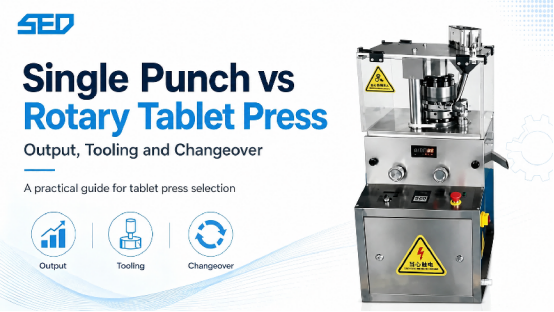
The practical choice between a single-punch and rotary tablet press depends on batch size, development stage, tablet dimensions, tooling strategy, changeover frequency, and the powder's compression behavior. A single-punch press is often easier to use for development, small batches, and frequent formulation changes because it compresses one tablet at a time and simplifies access to the tooling station. A rotary press is usually better suited to repeatable production because multiple stations compress tablets during each turret revolution. Neither design is automatically better: the correct selection follows the validated product requirement, not a headline speed.
Compare the Two Press Architectures
A single-punch press uses one die station and one compression event per cycle. The operator can inspect the die, punch, feeder, and ejection path directly, which is useful when a formulation is still being developed. Output is governed by stroke rate, fill depth, tablet geometry, dwell, and the time needed for inspection or manual handling. A rotary press carries multiple dies and punch sets around a turret. Several stations fill, compress, and eject in sequence, so the machine can produce more tablets per unit time once the formulation and tooling are stable.
The comparison below is a selection framework, not a universal capacity claim. Actual output depends on tablet diameter, thickness, compression profile, feeder design, powder flow, reject rate, and the qualified operating window.
| Selection factor | Single-punch press | Rotary press | Decision question |
|---|---|---|---|
| Development stage | Direct access and simple observation suit trials and formulation work | Better after product and process conditions are repeatable | Are formulation changes still frequent? |
| Output pattern | One compression station; output scales with cycle rate and handling | Multiple stations; output scales with turret stations and qualified speed | What is the required sustained output, not theoretical speed? |
| Tooling | Usually one punch-and-die set per format | Multiple upper and lower punches and dies; tooling inventory is larger | How many stations and spare sets are needed? |
| Changeover | Fewer parts and a shorter cleaning and access path in many setups | More tooling, feeder, turret, and compression checks | How often will formats or products change? |
| Compression behavior | Useful for observing one event and adjusting development trials | Enables production studies of dwell, precompression, and station-to-station consistency | Is the formulation ready for multi-station production? |
| Scale-up evidence | Good for early feasibility, but does not represent every rotary-station effect | Supports production-representative validation when matched to the final tooling | What evidence must the scale-up protocol generate? |
| Utilities and room fit | Often simpler for a small installation | May require more space, dust control, extraction, and handling integration | What are the room, dust, and utility limits? |
| Operator workload | Can require more manual intervention at small scale | More automation, monitoring, and tooling controls are typically required | What staffing and cleaning model is approved? |
Explore the Tablet Press Machine category
Match the Press to Batch Size and Output
Start with the required good tablets per hour, batch size, number of batches per shift, and annual product mix. Convert the requirement into effective output after setup, sampling, in-process checks, rejects, and planned cleaning. Do not compare a catalogue's maximum speed with a production target without accounting for tablet size, powder behavior, compression dwell, and quality sampling.
A single-punch press can be a rational choice when the requirement is small, the product is under development, or the organization values rapid access to the compression point. It can also be useful for clinical or engineering batches where a high-throughput turret would add complexity without improving the decision. A rotary press becomes more compelling when the same tablet format repeats, the production target requires multiple simultaneous stations, and the formulation has demonstrated stable feeding and ejection.
Use a product-and-batch worksheet before requesting a quote. Include tablet diameter and shape, target weight and thickness, compression-force range if already established, powder or granule flow indicators, batch size, target effective output, number of products, changeover time, sampling plan, and downstream equipment. If any value is not verified, label it as an engineering input to confirm rather than inventing a capacity.
Tooling and Tablet Geometry Are Selection Constraints
Tooling is not an accessory decision. Punch head profile, tip geometry, cup shape, keying, die bore, coating, and material must match the tablet and the press. A multi-station rotary press also requires a tooling inventory, storage and inspection method, punch-and-die traceability, and a plan for handling wear across stations. The correct number of spare sets depends on product mix, cleaning frequency, expected wear, and the site's maintenance strategy.
For a single-punch machine, one format may be easier to inspect and exchange, but the setup still needs documented punch and die condition checks. For either press, confirm tablet edge requirements, score lines, embossing, sticking or picking risk, ejection behavior, and compatibility with the feeder and take-off system. Obtain dimensions and tolerances from the equipment drawing, tooling drawing, URS, or approved supplier data; do not transfer a clearance or force value from another model.
Evaluate Changeover, Cleaning, and Cross-Contamination Risk
Changeover is a process, not only the time required to swap tooling. Map product contact parts, dust-release points, feeder access, turret or die-table cleaning, punch inspection, line clearance, recipe verification, first-off tablets, and documented release. A rotary press may offer excellent repeatability after setup but can require more parts and inspection points during a product change. A single-punch press may reduce mechanical complexity for short runs, while still requiring a validated cleaning method and product-specific line clearance.
Ask the equipment team to separate mechanical changeover time from total release time. Record who performs each activity, which tools are needed, how parts are identified, how cleaning status is confirmed, and what first-off checks are required. A short mechanical swap does not prove a short validated changeover.
Consider Formulation and Process Maturity
Powder flow, segregation, moisture sensitivity, lubrication, compressibility, elastic recovery, and ejection force affect both press types. Development work may need frequent changes to fill depth, precompression, main compression, dwell, feeder speed, or lubrication. These are formulation- and machine-dependent variables, not universal starting values.
Use a single-punch press when the immediate question is whether a formulation can form an acceptable tablet and how the material responds to controlled changes. Use a rotary press when the question includes station-to-station consistency, production-representative dwell, multi-station feeding, automated rejection, or integration with dedusting and inspection. Scale-up should include a documented bridge between the development press and the production press; a successful single-station tablet does not by itself prove rotary performance.
A Selection Workflow for a Defensible Decision
- Define the product and target output: tablet dimensions, dose, formulation, batch size, effective good tablets per hour, and product mix.
- Classify the operating mode: development, clinical, pilot, small commercial batch, or repeat production.
- Map tooling and changeover: format count, spare sets, cleaning access, line clearance, and inspection records.
- Confirm process evidence: flow, density, compressibility, ejection behavior, defect history, and the studies already completed.
- Check room and utilities: footprint, dust extraction, electrical supply, compressed air, noise, material handling, and operator access.
- Write acceptance tests in the URS: output at the defined tablet format, weight and thickness checks, force monitoring, reject challenge, changeover demonstration, cleaning access, and documentation.
Conclusion
Choose a single-punch tablet press when development flexibility, small batches, direct access, or a simple trial platform leads the decision. Choose a rotary press when repeatable production, multi-station output, automation, and production-representative process evidence justify the added tooling and setup controls. Confirm the decision with product data, effective output, tooling requirements, changeover evidence, and a URS-based FAT/SAT plan. SED Pharma can review your tablet dimensions, formulation stage, batch plan, tooling standard, target good output, and utility limits to help define a category-matched press specification.
Related Tablet Press Resources
- Single-Punch Tablet Press for Pilot and Small-Batch Production
- Rotary Tablet Press for Repeat Production
- Rising Tablet Ejection Force: Lubrication, Die Walls and Take-Off
- Tablet Press Tooling Replacement Guidance
- Tablet Defects Troubleshooting
Frequently Asked Questions
What is the main difference between a single-punch and a rotary tablet press?
A single-punch press compresses one tablet per cycle at one station, while a rotary press carries multiple punch-and-die stations around a turret. The choice depends on required effective output, process maturity, tooling strategy, and changeover needs.
Is a single-punch tablet press suitable for production?
It can be suitable for development, clinical, pilot, or small-batch production when the required good output is modest and frequent access or format changes matter. Confirm the decision against batch demand, quality checks, and the validated operating range.
How do I estimate tablet press capacity before buying equipment?
Start with good tablets per hour, then account for tablet size, qualified speed, rejects, sampling, setup, cleaning, and changeover. Use the resulting effective output in the URS instead of comparing a catalogue maximum with a production target.
What information should I send when requesting a tablet press recommendation?
Provide tablet diameter and shape, target weight and thickness, formulation stage, batch size, target good output, product count, tooling standard, changeover target, dust-control needs, and available utilities. These inputs allow a focused technical review.