Company News
How Do Pan Spray and Air Handling Systems Control Tablet Coating
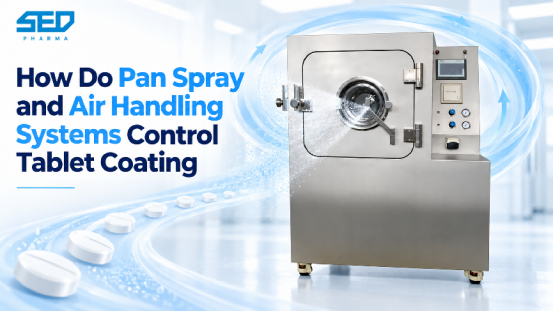
Tablet coating technology works when three systems produce the same outcome at the same time: the pan presents tablets evenly to the spray zone, the spray system deposits droplets at a rate the bed can accept, and the air-handling system removes water or solvent without overheating, over-drying, or destabilizing the bed. A defect is therefore rarely “a pan problem” or “an airflow problem” alone. Start by identifying where the defect appears, then compare the tablet bed, the spray pattern and the inlet/exhaust trend under the approved process conditions. Adjustments that affect product quality must be evaluated through the site SOP, risk assessment and validation process.
The coating system is a coordinated drying and distribution loop
In a perforated pan coater, baffles lift and turn the tablet bed while the rotating drum carries tablets through a defined spray zone. Pumps, lines and guns meter and atomize coating liquid into that moving bed. Conditioned inlet air supplies the energy to evaporate the carrier, while the exhaust path removes the resulting vapor and helps maintain the intended pressure relationship. The formed film is the accumulated result of thousands of short wetting and drying events—not simply the result of a set spray rate.
A stable run keeps three balances in range: enough tablet movement to expose all surfaces; enough droplet quality and coverage to avoid localized overwetting; and enough drying capacity to prevent the bed from becoming progressively wetter. Exact values depend on formulation, coating solids, core geometry, batch load, machine scale and validated process design. For that reason, a number copied from another coater is a starting question, not a setpoint.
For the site’s product family and equipment context, see the Film Coating Machine category. The category supports equipment discovery; the process settings still need to be matched to the product and qualified on the selected machine.
What the pan contributes to tablet coating technology
The pan creates tablet circulation. Its speed, loading level, baffle geometry, drum angle and tablet properties determine whether tablets roll, cascade, slide or remain in a poorly mixed mass. The objective is repeatable exposure: each tablet should pass through the spray zone often enough, with enough movement afterward to spread droplets and release moisture before the next wetting event.
Too little movement can leave a dense or localized bed. Spray then concentrates on a limited population of cores, increasing the risk of sticking, twinning and color non-uniformity. Excessively aggressive movement may increase attrition, edge chipping or dust; it can also shorten the time a tablet remains in the intended spray area. A change in pan speed should therefore be judged by bed motion and finished-film response, not by speed alone.
Before changing a mechanical setting, inspect the bed through the viewing window or approved camera system. Look for stagnant zones, abrupt avalanching, tablets trapped near baffles, and changes in bed depth as the batch warms. Confirm that the actual load and core characteristics match the batch record. A sound tablet-coating process cannot compensate indefinitely for friable, dusty or dimensionally variable cores.
How the spray system sets the wetting load
The spray loop controls how much liquid reaches the bed and in what droplet form. Pump output, gun count, gun-to-bed distance, gun angle, atomization air, pattern air where fitted, solution temperature, solids and viscosity all influence deposition. The practical target is a controllable, evenly distributed wetting event that reaches the moving cores rather than the drum wall, baffles or exhaust path.
A higher liquid rate does not automatically increase useful output. When the evaporation demand exceeds the available drying capacity, droplets can coalesce on the tablet surface. Picking, sticking, roughness and logo bridging may follow. Conversely, very fine droplets or an excessively dry environment can cause spray drying: solids dry before they spread and adhere, producing a rough, porous or low-efficiency film. Nozzle buildup, pulsation, partially blocked filters and unequal gun output can create the same visual pattern as an incorrect setpoint.
During troubleshooting, verify the delivered liquid rather than relying only on the recipe value. Check pump calibration, tubing condition, gun triggering, nozzle cleanliness and the actual spray pattern according to the approved maintenance procedure. If one side of the bed shows a defect, compare gun alignment and coverage before changing global airflow or pan speed.
How air handling closes the drying balance
Air handling provides heat and vapor-removal capacity. Inlet temperature, inlet airflow, inlet moisture condition, exhaust airflow, exhaust temperature, filtration condition and negative pressure influence how quickly the carrier leaves the deposited film. The tablet-bed temperature is especially useful because it reflects the balance between incoming heat, evaporation and tablet mass, but it must be interpreted with the machine’s sensor location and process design in mind.
Insufficient usable airflow or a restricted exhaust can lengthen the wet period after each spray pass. The bed may become tacky even if the inlet temperature appears normal. Excessive drying energy can push the process toward spray drying or damage a heat-sensitive formulation. Negative pressure should be stable enough to contain dust and vapor without disrupting the spray plume or drawing droplets away from the tablet bed. Filter loading, damper position, duct condition and room-air changes can all alter that balance.
For basic equipment inspection points, link readers to How to Use and Maintain the Coating Machine. Maintenance is necessary, but process changes must still follow the approved change-control path.
Symptoms, confirmation tests and first actions
| Observed symptom | Possible system cause | Confirmation test | First controlled action |
|---|---|---|---|
| Twinning or sticking | Wet load exceeds local drying or poor bed circulation | Review bed motion; compare spray rate, exhaust trend and gun coverage | Confirm load and gun alignment; reduce wetting burden only within approved limits |
| Rough, dusty film | Spray drying, poor atomization or insufficient spreading | Inspect nozzle condition and plume; compare bed temperature and surface texture | Verify atomization and air balance before changing coating formulation |
| Color variation | Uneven exposure, unequal gun output or variable solids | Map defect location; check mix agitation, pump delivery and pattern overlap | Restore uniform liquid preparation and coverage; document observations |
| Peeling or weak adhesion | Core surface, excessive early drying or unsuitable film formation conditions | Inspect cores and early coats; review preheat and drying history | Escalate to formulation/process review; do not assume a mechanical root cause |
| Localized wet marks | Misaligned gun, damaged nozzle, air disturbance or wall spray | Run an approved pattern check and inspect gun-to-bed geometry | Clean/align the affected gun and verify containment-air stability |
Fast defect triage
Use this table to choose the first system to verify. It is a prioritization aid, not a root-cause conclusion; confirm the signal against the approved batch record before changing settings.
| Defect | Priority system to check | Confirmation signal |
|---|---|---|
| Twinning or sticking | Drying balance and pan circulation | Tacky bed, rising wetness trend, or tablets remaining in contact |
| Rough or dusty film | Spray atomization and inlet-air condition | Poor plume/nozzle condition or premature drying before spread |
| One-sided color variation | Local gun delivery and pattern overlap | Defect maps to a gun zone or unequal delivered liquid |
| Logo bridging | Wetting load, core detail and film formation | Loss of detail tracks with high local wetness or weak core features |
| Localized wet marks | Gun alignment and containment air | Wall spray, distorted plume, or marks closest to one spray zone |
A disciplined troubleshooting sequence
- Preserve the evidence. Record the batch stage, defect location, time trend, operator observations, current recipe, alarms and available process trends before any adjustment. Photograph representative defects under the approved documentation procedure.
- Confirm the tablet bed. Verify batch load, core condition, pan rotation and circulation. This separates poor presentation from a spray or drying problem.
- Confirm liquid delivery and spray geometry. Compare actual pump delivery, gun operation, nozzle condition, line pressure where relevant, spray pattern and gun-to-bed distance. Check coating suspension agitation and preparation status.
- Confirm the drying path. Review inlet and exhaust trends, pressure behavior, filters, dampers and any changes in room conditions. Do not interpret one temperature value without the related airflow and process stage.
- Make one justified change at a time under the approved protocol. Monitor the response long enough to distinguish a true improvement from normal batch variability. If the defect crosses a quality threshold, pause and follow the deviation or escalation procedure.
Equipment selection should expose the controls you need
A coater should let the process team observe and control the variables that matter for the intended product: reproducible pan movement, cleanable and serviceable spray assemblies, stable liquid delivery, conditioned supply air, reliable exhaust control and a usable record of the process. The needed configuration differs between development, pilot and production scale. Capacity alone does not confirm that a machine can reproduce the spray-zone geometry or drying response of another coater.
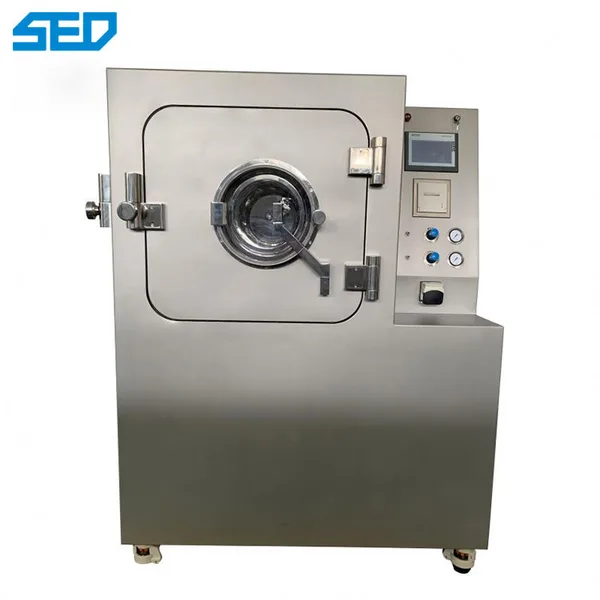
As an example of an on-site equipment page to review with the process requirements, see the Auto Pill Capsule Tablet Pills Coating Machine. Its published product page describes adjustable drum operation, supply/exhaust equipment and controlled spray features; confirm all configuration details against the final quotation and acceptance scope.
Do not transfer a recipe without transferring its context
A coating recipe is more than a list of temperatures, spray rates and pan speeds. The same nominal settings can produce a different response when the drum diameter, baffle design, batch loading, air volume, gun geometry, liquid solids or inlet-air moisture changes. This is why scale-up and equipment transfer need a structured comparison of the process conditions, rather than a direct setpoint copy. The process team should identify the measured attributes that demonstrate an equivalent tablet bed, spray exposure and drying response.
Trend review is most useful when it connects the process stage to a physical observation. For example, an upward drift in exhaust humidity together with a tackier bed may support an investigation of drying capacity, while a defect isolated near one gun may point first to local delivery or alignment. Neither pattern proves a root cause on its own. Compare it with nozzle inspections, filter status, batch load, coating-liquid preparation and core characteristics before assigning corrective action.
When a change is proposed, define the expected mechanism and the evidence needed to accept or reject it. A small, controlled change may be appropriate in development or under an approved protocol; a commercial change may require formal assessment, documented justification and qualification. This approach keeps troubleshooting technically useful without treating a production process as an informal trial.
This lifecycle approach is consistent with ICH Q8(R2) Pharmaceutical Development, which describes a control strategy based on product, formulation and process understanding. For commercial manufacturing, the related evidence and lifecycle expectations should be evaluated against the site quality system and applicable regulatory requirements.
Conclusion
Tablet coating technology is controlled by balance, not by one “correct” number. The pan must present tablets consistently, the spray system must add a manageable wetting load, and the air-handling system must remove the carrier at the same pace. When defects appear, examine the interaction first: bed movement, actual spray delivery and the drying path. SED Pharma can help frame an equipment discussion around the product, target batch size, coating liquid properties, utilities and control requirements, while the manufacturer retains responsibility for formulation development, validation and batch-release decisions.
For an initial technical discussion, start at the SED Pharma homepage enquiry section and share defect photos, tablet-core properties, coating-liquid details, batch load, current approved settings, and inlet/exhaust trend data. The team can use that context to identify which tablet coating equipment and control questions should be reviewed first.
Frequently asked questions
Which signal should be checked first when a coating defect appears
Start with the defect location and the process stage, then inspect the tablet bed, actual spray delivery and the drying path together. A single exhaust-temperature value or one visual symptom is not enough to establish a root cause.
Can increasing inlet temperature solve sticking
Not reliably by itself. Sticking can involve the wetting load, gun alignment, pan circulation, core properties and the available drying capacity. Raising drying energy can also create other risks, including premature drying or heat exposure. Use approved development or deviation procedures to assess any change.
Why can the same exhaust temperature give different coating results
Exhaust temperature does not fully describe the tablet-bed microenvironment. Published pan-coating research reports that different spray-rate and inlet-humidity conditions can produce different tablet-bed conditions at the same exhaust temperature. Review the related airflow, humidity and spray trends before drawing a conclusion.
How should a process be transferred to another coating pan
Do not transfer nominal setpoints alone. Compare pan geometry, baffles, loading, tablet movement, gun-to-bed geometry, liquid properties and the air path, then establish equivalence through the approved transfer and qualification strategy.
When should the batch be escalated instead of adjusted
Escalate when the defect may affect a critical quality attribute, a trend exceeds the approved operating range, or the required adjustment is outside the established process knowledge. Follow the site deviation, quality-risk and release procedures.
Sources and technical review
The control-strategy discussion is informed by ICH Q8(R2) Pharmaceutical Development and the FDA Process Validation guidance, which describe science- and lifecycle-based process control and validation principles.
For coating-specific evidence on the interaction of spray rate, atomization, inlet air and tablet-bed conditions, see the peer-reviewed open-access study on pan-coating microenvironmental factors.
Related article
How to Build a Complete Pharmaceutical Production Line for Tablets and Capsules.
Making Pills: Do I Need Both a Tablet Press and a Coating Machine?.