Company News
Desiccant Inserter Machine: Canister Matching, Insertion Control and Bottle-Line Integration
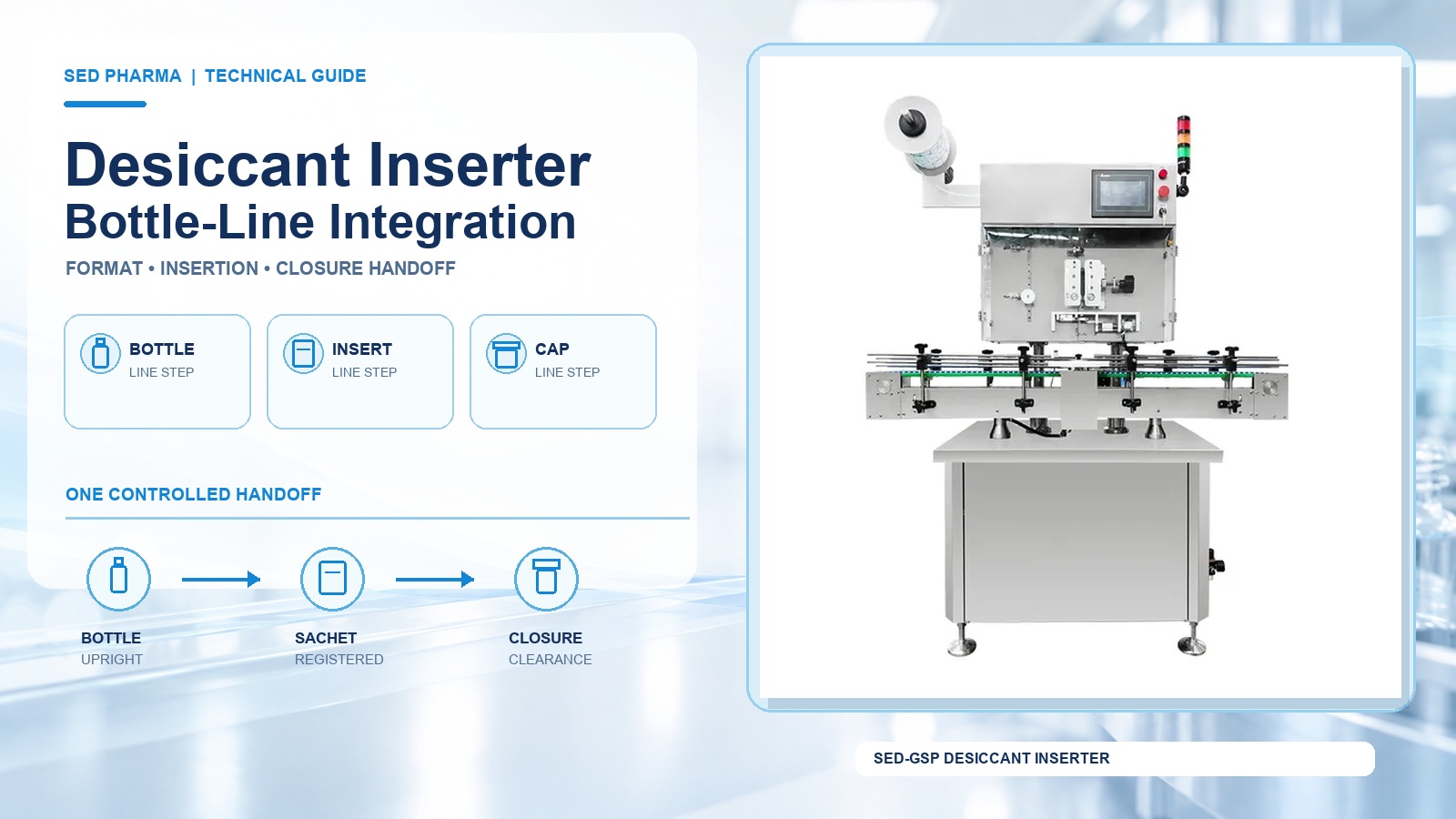
A desiccant inserter machine works reliably only when the bottle, desiccant roll, bottle presentation, and downstream closure process are treated as one system. The most common insertion faults are not solved by simply increasing machine speed: a bottle can arrive off-center, a bag can be cut at the wrong registration point, or the line can accumulate bottles after a short stop. Start by confirming format compatibility and bottle position, then verify roll tracking and timing against the actual line speed. Finally, prove that the inserted sachet clears the neck, cap, and seal process under representative operating conditions.
The article applies to preformed desiccant sachets cut from a roll and inserted into rigid pharmaceutical, nutraceutical, or supplement bottles. Exact limits for bottle dimensions, sachet size, sensor settings, and output depend on the machine configuration, components, product, and approved operating procedure.
Where the Inserter Fits in a Bottle Line
The inserter belongs after the bottle has been oriented and filled, but before the closure is applied. In a typical solid-dose line, bottle handling, counting or filling, desiccant insertion, capping, induction sealing, labeling, and collection each have their own controls. The point of integration is not merely physical conveyor connection. Each station must release bottles with spacing, orientation, and stability that the next station can accept.
A stable stream of upright bottles and a repeatable neck position are prerequisites for reliable desiccant placement. If bottle dimensions, container material, or shoulder geometry change, recheck the insert station before increasing output.
Match the Bottle and Desiccant Format Before Setting Speed
A compatible format is a relationship among the bottle opening, internal clearance, bottle height, sachet width and length, and the path of the insertion fingers or chute. A bag that passes through the neck can still bridge at the shoulder, catch on a thread finish, or sit where it interferes with closure application. A format assessment should therefore include both static fit and dynamic release.
Bottle features that affect insertion
- Neck finish and clear opening: confirm the usable opening, not only the nominal bottle diameter. Threads, tamper-evident features, and neck ovality may reduce clearance.
- Shoulder transition and internal geometry: a steep shoulder or narrow internal ledge can make a sachet hang up after it clears the neck.
- Bottle height and base stability: the stopper or positioning device must locate the bottle consistently without crushing or tilting it.
- Material and surface condition: lightweight bottles can flex under guides or static charge can influence a light sachet. Evaluate representative bottle lots rather than one ideal sample.
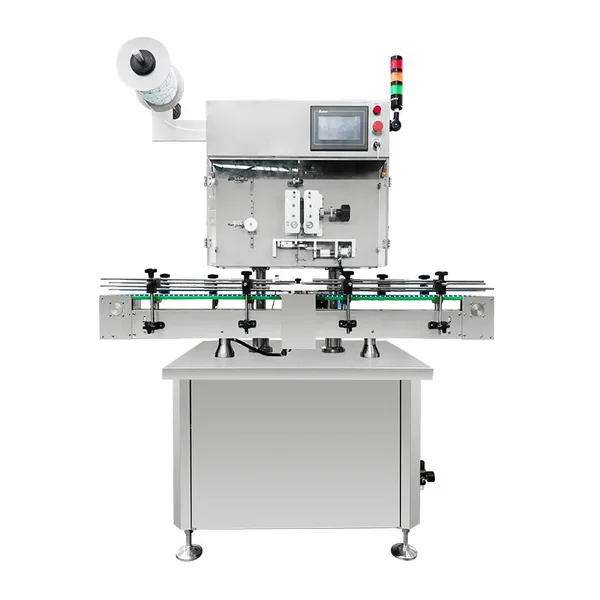
The assigned product page identifies model SED-GSP with double-lane photoelectric positioning, intelligent feed-length control, and accumulated-length error adjustment. Its published configuration lists 85-90 bottles per minute for round, oval, square, and flat-square bottles; 0.6 Mpa air; 220 V 50 Hz; and 0.5 kW. Treat these as configuration-specific reference points, not universal limits: confirm the actual bottle, desiccant roll, product, and approved line conditions during the format trial.
A color-mark and photoelectric-positioning configuration is relevant when the application requires repeatable roll registration and bottle-present control.
Control the Cut and Insertion Event
A color-mark or photoelectric system can support repeatable roll registration, but it needs clean, consistent evidence from the material and the bottle path. The useful question is not “Is the sensor on?” It is “Does every detected mark lead to one correctly cut sachet that reaches the intended bottle before the next cycle begins?” Diagnose the roll path and bottle path separately before coupling their timing changes.
What to observe during a controlled check
- Mark several consecutive sachets and compare the cut location relative to each printed or color registration mark.
- Observe whether a bag reaches the bottle when the line is first started, at nominal speed, and after a permitted stop/restart condition.
- Check the bottle-stop position using a marked container; confirm that the neck center repeats relative to the insertion path.
- Inspect the finished bottle before capping for a folded, bridged, or visible sachet at the neck. Use the site’s approved method for any product-contact inspection.
Do not change sensor sensitivity, feed length, and conveyor timing all at once. Hold the bottle format and line speed constant, make one authorized adjustment, and record the result. If a change can affect validated packaging or product quality, follow the site SOP, risk assessment, and change-control process.
Cause Test Action Diagnostic Table
| Possible cause | Confirmation test | Corrective action |
|---|---|---|
| Sachet cut is early, late, or variable | Compare cut position on a planned sequence of marked sachets; inspect roll tension, registration mark contrast, and sensor cleanliness. | Restore the approved roll path and sensor condition; set the authorized feed length, then recheck at normal and restart conditions. |
| Bottle is not centered under the inserter | Mark bottle position at the stop and compare several cycles; inspect guides, stop cylinder, conveyor vibration, and bottle stability. | Correct guide and stop settings for the approved format. Reconfirm neck position before changing insertion timing. |
| Sachet bridges at the neck or shoulder | Inspect accepted and suspect bottles before capping; compare bottle opening, shoulder geometry, sachet dimensions, and release path. | Hold the affected format; assess a compatible sachet or approved format part. Do not force a marginal bag through the neck. |
| Missing sachet after a short stop or restart | Run the approved stop/restart challenge and trace bottle spacing, sensor state, and first-cycle sequence. | Adjust the approved synchronization or reject logic; verify that the first bottles after restart are controlled and documented. |
| Double insertion or a sachet remains at the feed point | Count sachets at the roll, cut station, and bottles; look for static, poor separation, drag, or delayed release. | Clean and inspect the feed path; correct the material handling condition and verify single-sachet separation before returning to production. |
| Downstream cap or seal disturbance | Inspect whether the sachet protrudes into the neck or is displaced before closure; correlate findings with capper and sealer conditions. | Correct insertion placement first, then repeat the downstream trial with representative components and approved packaging tests. |
Set the Line Speed from the Bottleneck, Not the Fastest Station
A desiccant inserter machine should be specified and operated against the line’s usable, sustained output. A nominal machine rate does not account for bottle gaps, accumulated bottles, product-filling interruptions, rejected units, format changes, or downstream dwell limits. The inserter must have enough time to detect the bottle, stop or locate it if required, cut and release one sachet, and clear the station before the next bottle reaches the control point.
A practical line study begins with actual bottle spacing at the inserter inlet. Record the nominal conveyor speed, real bottle arrival pattern, stop length, the completion signal for the insertion cycle, and the handoff to the capper. If the count or fill station delivers an irregular flow, an accumulation strategy or interlock may be more appropriate than forcing the inserter to chase every gap. Capacity and timing settings should be developed with the machine supplier and qualified under the site’s intended operating conditions.
Integrate with Capping and Induction Sealing
Insertion is only successful if the sachet remains safely inside the bottle through closure and sealing. Before running a line trial, define where and how the team will inspect sachet location, cap seating, and final package integrity. A sachet caught in the thread zone can create a cap-height issue, an incomplete closure, or a subsequent seal defect. The evidence should distinguish an insertion problem from a capper or sealer problem.
A misplaced sachet should be corrected at the insertion station before the team changes capper or sealer settings. Preserve the bottle, closure, sachet, product, and line-condition identities throughout the trial so that an insertion fault is not misclassified as a downstream closure or sealing problem.
During an integrated trial, take representative bottles before capping, after capping, and after sealing. Keep the same bottle, cap, sachet, product, and line-condition identities in the record. Evaluate startup, nominal running, and expected brief-stop conditions. Acceptance criteria, sample quantities, and test methods must come from the validated package system or the site’s approved protocol; this article does not set universal numerical limits.
A Stepwise Format and Line-Integration Check
- Define the package set. Collect the approved bottle drawing or sample, neck-finish information, closure, desiccant sachet roll specification, product form, target output, and downstream equipment sequence.
- Prove static compatibility. With the machine safe and isolated as required, verify that the intended sachet can pass the real bottle opening and settle without bridging or interfering with the neck.
- Set the bottle path. Use the approved guides, stop, and format parts to establish repeatable bottle position. Check several bottles from representative lots.
- Establish roll registration. Verify material loading, roll tension, sensor condition, and cut location before introducing bottles at production speed.
- Couple one variable at a time. Run a limited authorized study at a fixed line condition. Change one timing or control variable, inspect the result, and keep a traceable record.
- Challenge the normal disturbances. Evaluate permitted startup, stop, restart, and spacing variation conditions. Confirm alarms, rejects, and handoff behavior without bypassing guards or interlocks.
- Confirm the finished package. Check insertion location before closure and then apply the approved closure and package-integrity evaluation. Escalate any quality-impacting change through the established quality system.
What to Include in an Equipment Inquiry
SED Pharma can review an insertion application more efficiently when the request describes the package as a system. Provide bottle and neck dimensions, representative container photos, desiccant roll and sachet dimensions, product form, target sustained output, line sequence, available utilities, and any observed defect photos or videos. This creates a basis for discussing format compatibility, sensor arrangement, conveyor integration, and the product configuration rather than selecting a machine from capacity alone.
| Parameter to provide | Why it matters |
|---|---|
| Effective bottle-neck opening and bottle height | Confirms clearance at the insertion point and the required guide or stop position. |
| Desiccant sachet width, length, thickness, and roll or mark format | Determines the feed path, cut registration, and whether the sachet can clear the neck and shoulder. |
| Target sustained output and current conveyor speed | Aligns the insertion cycle with real bottle spacing rather than a nominal machine rate. |
| Existing upstream and downstream interface | Identifies bottle handoff, spacing control, alarms, rejects, capping, and sealing integration requirements. |
SED Pharma supports bottle-packaging projects across a wider pharmaceutical machinery equipment range. Send the bottle, sachet, and line details through the technical inquiry form when the application is ready for configuration discussion.
Conclusion
A desiccant inserter machine is a controlled handoff between the filled bottle and the closure process. Reliable performance starts with the real bottle opening, shoulder, and sachet dimensions; continues through repeatable roll registration and bottle positioning; and ends with proof that the sachet clears capping and sealing. Use a structured format trial, isolate one variable per change, and verify normal running as well as expected stop/restart conditions. That approach makes bottle-line integration more defensible than tuning a single speed or sensor setting in isolation.