Company News
Sterile Liquid Filling Machine: Defining Cleanroom, CIP/SIP and Container-Closure Requirements
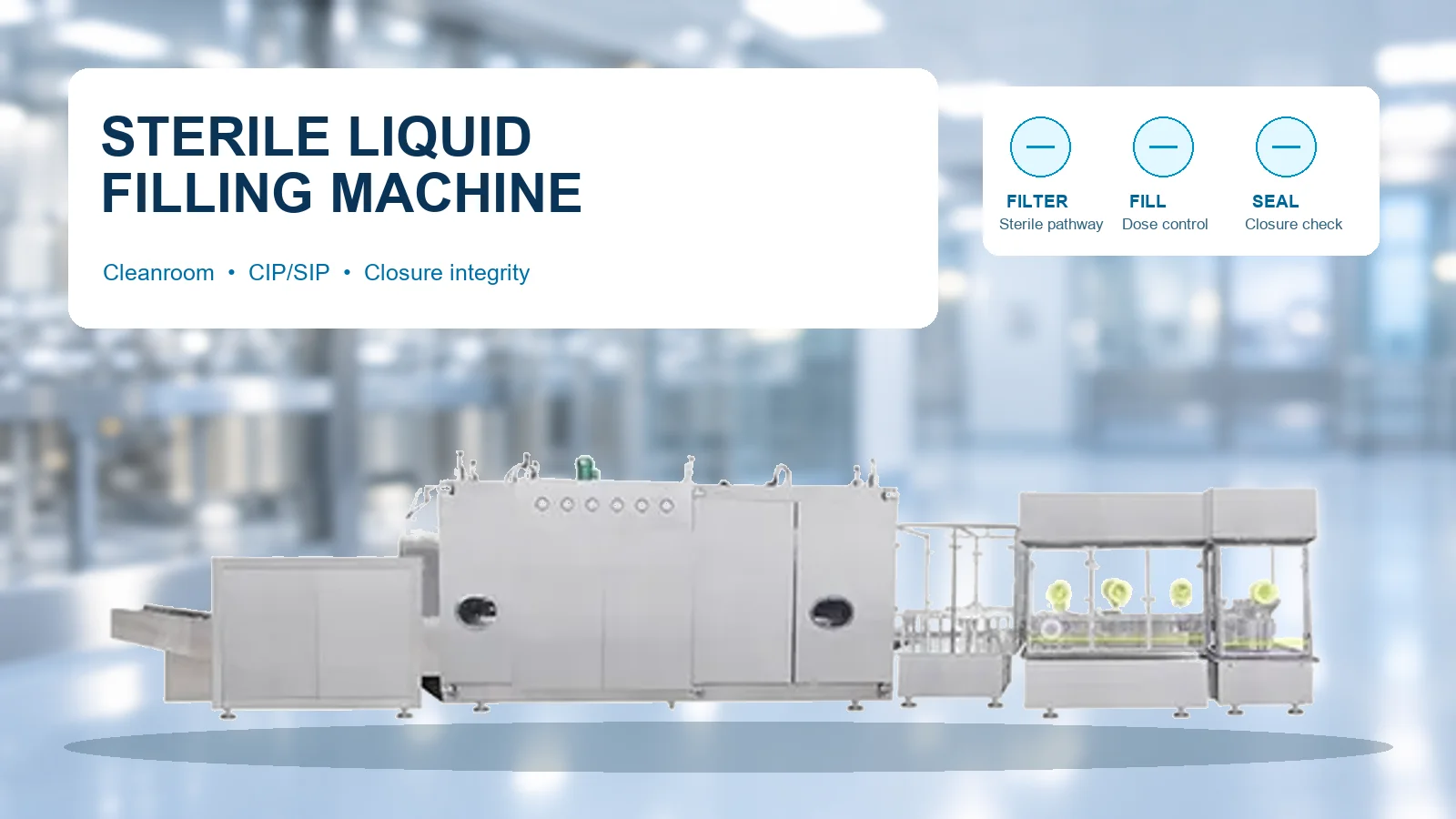
A sterile liquid filling machine should be specified from the aseptic process outward. Start with the container, closure, formulation, sterilization strategy and intervention plan; then define the cleanroom interface, clean-in-place or sterilize-in-place scope, and container-closure tests. A quoted filling speed or nominal accuracy does not establish an aseptic process. The final configuration must be confirmed through product-specific risk assessment, qualification and validation.
Define the aseptic boundary before choosing a filler
Map each item that can contact sterile product or its critical path: product feed, filter outlet, hold vessel, transfer tubing, filling needle, container, closure and stopper or cap application. For each, state the sterilization method, connection method, maximum hold time and how the boundary is protected during setup, operation and intervention. This map determines whether an open, restricted-access, isolator or other line concept is appropriate; it is not a generic cleanroom decision.
The cleanroom specification must describe the local protection required at exposed product and closure points, material and personnel flows, pressure relationships, environmental monitoring interfaces and maintenance access. Avoid selecting a machine footprint before confirming room layout and utilities. FDA notes that aseptic processes should minimize exposure and unnecessary activities around exposed product and closures.
Source: FDA aseptic-processing guidance
Set the target market and GMP framework in the URS
State the intended market and governing GMP framework before assigning any room classification or barrier technology. For example, a U.S.-market project should identify applicable FDA CGMP requirements and the site’s interpretation of the FDA aseptic-processing guidance; an EU-market project should identify the applicable EU GMP framework and Annex 1. The URS must name the cleanroom classification basis, the critical-zone protection concept, and the acceptance evidence for that chosen framework. Do not state that a filler is “GMP compliant” without these project-specific decisions.
Specify CIP/SIP as a verified process, not an option label
Ask the supplier to define exactly which product-contact circuits are covered, the required utilities, drainability, dead-leg management, sensor locations, cycle recipes and evidence generated by the controller. CIP may reduce disassembly and improve repeatability, but it does not by itself prove cleaning effectiveness. SIP similarly requires defined parameters, verified delivery to the required locations, alarms and records. If any connection or part is outside the automated cycle, state its manual procedure and sterile connection controls.
For each product family, establish the cleaning and sterilization acceptance approach before purchase: residues or bioburden as applicable, rinse sampling points, worst-case product, hold times, changeover sequence and release documentation. The site quality unit must approve limits and validation methods.
Match container closure to the process and inspection plan
The container and closure are part of the sterile product system. Document the container material and format, neck finish, stopper or cap geometry, torque or placement range, supply preparation, transfer to the filling zone and any vision or reject checks. Define the container-closure integrity test method, sampling plan and acceptance criteria for the marketed configuration. A seal that looks acceptable at the machine does not demonstrate integrity over its shelf life.
FDA states that a sterile-product container closure system must protect against foreseeable contamination and that systems unable to maintain integrity after sealing are unsuitable.
Source: FDA aseptic-processing guidance: container-closure integrity
Use a requirements matrix before issuing the URS
| Requirement | Confirmation evidence | Owner |
|---|---|---|
| Target GMP and cleanroom basis | Named target market, GMP framework, room-classification basis and critical-zone concept | Quality / Engineering |
| Critical-zone protection | Layout, airflow concept, intervention review | Engineering / QA |
| CIP/SIP coverage | P&ID, cycle parameters, utility and alarm list | Supplier / Engineering |
| Sterile filtration and integrity | Filter train, sterilization method, pre/post-use integrity-test approach and hold-time ownership | Process / QA |
| Media fill / APS readiness | Representative interventions, duration, line configuration and documentation requirements | Quality / Validation |
| Environmental monitoring | Viable and nonviable monitoring points, alarm limits, trend review and excursion response | Microbiology / QA |
| Dose and fill range | Representative-material run and approved sampling plan | Process / QA |
| Closure integrity | Defined test method, samples and acceptance criteria | Packaging / QA |
Test the integrated line, not only the filling head
A factory or site acceptance protocol should cover representative containers, closure components and product-simulating liquid, the normal and worst-case operating range, defined interventions, reject handling, cleaning or sterilization interfaces and record review. Include the support needed for aseptic process simulation (media fill/APS), filter integrity-test interfaces, maximum product and sterile-hold times, and environmental-monitoring alarms, trend review and escalation. State the run duration, accepted downtime and scrap categories before the test. Sample fill weight or volume and closure condition at startup, defined intervals and end of run. The protocol must state the product-specific acceptance criteria and the action for a failed result.
Next step
Before requesting a configuration, send SED Pharma the formulation description, fill range, container and closure drawings, target output, cleanroom concept, utility list, cleaning and sterilization strategy, and proposed acceptance tests. Review the SED Pharma liquid filling machine category. For the scheduled product reference, review the aseptic plastic bottle automatic liquid filling machine.