Company News
Ribbon Blender Uses in Pharmaceutical Powder Processing

Ribbon blender uses in pharmaceutical powder processing are most defensible when the material can be moved and redistributed by the ribbons without excessive smearing, attrition, or segregation. A horizontal ribbon blender can be useful for dry powder preblends, excipient blends, and some granule blends, but suitability depends on the particle-size distribution, density difference, flow behavior, dose level, and cleaning or containment requirements. Start by defining the material behavior, then confirm the loading range, mixing pattern, discharge behavior, and blend-uniformity evidence in a representative trial.
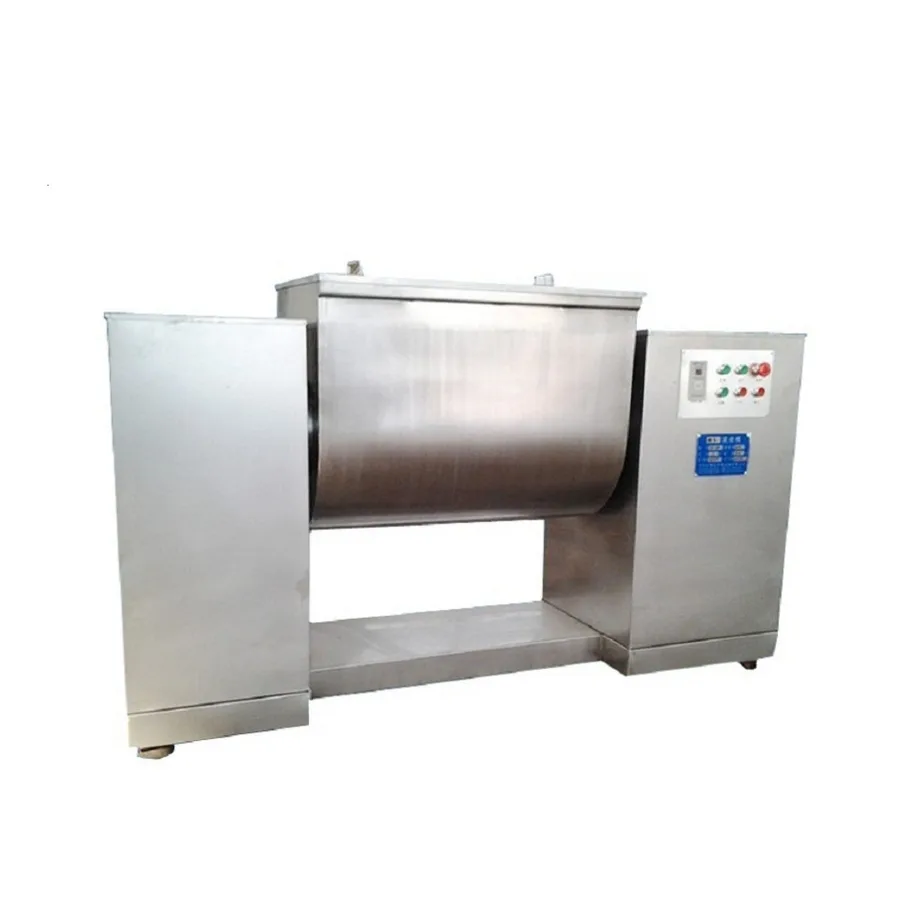
What a ribbon blender does
A horizontal ribbon blender has an outer and inner helical ribbon on a common shaft inside a U-shaped trough. The ribbons create opposing axial movement while material is also lifted and circulated through the bed. This convective motion can reduce mixing time for compatible dry solids, but it does not make every powder system easy to blend. The vessel geometry, ribbon clearance, fill level, speed, and discharge arrangement all affect the movement observed in a real batch.
Where ribbon blender uses fit
Typical ribbon blender uses include blending dry excipients before a downstream process, combining a granulated base with selected external-phase ingredients, distributing a noncritical powder addition into a larger free-flowing blend, and preparing blends for transfer to a tablet press or capsule filler. These are application categories, not automatic approvals. A low-dose active, a highly cohesive fine powder, a wide density contrast, a fragile granule, or a material with electrostatic behavior may need a different mixer, a premix strategy, altered addition order, or further development work.
Loading and addition strategy
Do not choose a working load from nominal vessel volume alone. Too little material may not establish the intended circulation; too much may restrict movement and leave material near the top or ends insufficiently exchanged. The approved load range must come from the equipment, material, and validated conditions. Addition order also matters. A small component added into a large bulk can be difficult to distribute if it enters one location and remains as a local pocket. When the formulation requires a preblend, make the preblend ratio, charge sequence, and sampling plan part of the controlled process rather than an operator preference.
Why a visually uniform blend can still fail
Color or appearance can be useful for detecting gross nonuniformity, but it is not proof that a low-level component is evenly distributed. Samples should be taken from locations that can challenge the expected mixing pattern and should use the approved analytical method. Compare samples over time rather than selecting one convenient end point. If a blend meets a visual check but fails chemical uniformity, investigate sampling representativeness, feed order, particle size and density differences, ribbon condition, loading level, and possible segregation during discharge or transfer.
Symptoms, possible causes, confirmation tests, and controlled actions
| Observed condition | Possible cause | Confirmation test | Controlled action |
|---|---|---|---|
| Blend has repeating high and low assay results | Local addition pocket, inadequate circulation, nonrepresentative sampling, or a damaged ribbon | Review charge sequence and sampling map; inspect ribbon clearance and product distribution | Correct the verified setup or mechanical cause; repeat a controlled trial under the approved plan |
| Blend changes after discharge | Segregation in discharge, receiver, or transfer route | Compare mixer and downstream samples; inspect flow path and transfer behavior | Address the confirmed transfer mechanism before changing mixer settings |
| Powder builds on ribbon or trough | Cohesive material, moisture effect, unsuitable loading, or surface residue | Inspect material condition, cleaning status, load, and deposits | Restore the verified condition; assess material and equipment fit through change control |
| Mixing time increases without a quality gain | Changed material flow, overloading, worn component, or trial method issue | Compare material properties, load, current draw if available, and sample trend | Do not extend time by default; isolate the cause with one controlled test |
Segregation boundaries
Ribbon blending can create a uniform bulk and still leave the process vulnerable after mixing. Segregation can occur while a blend falls through a discharge valve, enters a hopper, travels through a transfer line, or experiences vibration. Larger or denser particles may behave differently from fines, and a cohesive powder may form agglomerates that the ribbons do not disperse. Diagnose the whole path: sample the mixer, the discharge stream where justified, and the downstream receiver. A change that improves mixer samples but worsens post-transfer samples does not solve the process problem.
Cleaning containment and mechanical checks
For pharmaceutical use, review product-contact surfaces, seals, shaft entries, discharge valve geometry, access points, cleaning method, dust control, and retained-material locations. A ribbon that is bent, worn, loose, or coated with product can change the circulation pattern. Before changing speed or time, inspect the equipment condition and confirm the recipe, load, rotation direction, and addition sequence. Any adjustment that could affect product quality, cleaning status, or validation must remain within the approved SOP, risk assessment, and validation procedure.
A practical investigation sequence
- Confirm the formulation and material boundary: dose level, particle-size distribution, density, flow, moisture sensitivity, electrostatic behavior, and fragility.
- Verify the installed configuration, ribbon condition, rotation direction, vessel cleanliness, discharge valve, and approved working load.
- Review the charge order and any preblend requirement before starting the batch.
- Run the planned mixing interval and collect samples with the approved locations, timing, and analytical method.
- Check the discharge and downstream transfer route for segregation or hold-up.
- Use the evidence to confirm the configuration or investigate one supported cause at a time.
Equipment selection and related resources
For a commercial starting point, review the Powder Mixer Machine category and the Horizontal Ribbon Powder Mixer Machine 300L product page. Related process context is available in the Diffusion Mixers article and the Effervescent Tablet Production guide. These pages support equipment context, but the final process and acceptance criteria must come from the product development and validation program.
- Powder Mixer Machine category
- Horizontal Ribbon Powder Mixer 300L
- Diffusion Mixers
- Effervescent Tablet Production
- SED Pharma home
- Technical inquiry
Ribbon blender selection boundary
| Use case | Decision | Reason to test |
|---|---|---|
| Dry, free-flowing powders or compatible granules | Suitable to evaluate | Confirm loading range, blend uniformity, discharge, and cleaning. |
| Low-dose addition, density or particle-size contrast, cohesive or electrostatic powder | Requires formulation-specific verification | A preblend, controlled addition method, or different mixer may be needed. |
| Fragile particles, high segregation risk after discharge, or material that smears or bridges | Not a first choice without evidence | Assess attrition, transfer segregation, and the complete process path before selection. |
Process condition and equipment direction matrix
| Process condition | Primary failure risk | First verification | Possible equipment direction |
|---|---|---|---|
| Free-flowing dry powders or compatible granules | Incomplete axial exchange | Representative mixer and discharge samples | Ribbon blender can be evaluated alongside containment and cleaning. |
| Low-dose addition, density or particle-size contrast, or electrostatic behavior | Local pockets or post-mix segregation | Premix, repeated samples, and transfer check | Evaluate ribbon, paddle, bin, or another configuration through trials. |
| Friable particles or granules | Attrition and changed downstream performance | Compare particle-size evidence before and after blending | A gentler bin or tumble blender may merit evaluation. |
| High residue concern or strict closed transfer need | Unverified cleaning or exposure-control gap | Cleaning access, hold-up, and containment risk review | Do not assume ribbon is the default; review the full process boundary. |
How to separate mixer uniformity from transfer uniformity
A representative study should distinguish the material state inside the mixer, the discharge stream, and the material after transfer. FDA cGMP questions and answers emphasize that blend sampling needs a scientific and representative plan and that location and replicate variability matter. A powder thief can disturb the bed, so its use and sampling location must be justified rather than treated as neutral.
| Stage | Location logic | Replicates | Detection method | Decision and next action |
|---|---|---|---|---|
| Mixer | Challenge expected low-exchange areas | Approved independent samples and repeats | Validated product-specific method | Quality and process owner assess before changing settings. |
| Discharge | Early, middle, and late stream where risk supports it | Repeat samples for stream variation | Same method and sample handling | Investigate valve behavior and segregation before changing time. |
| Downstream receiver | After the actual transfer route | Approved plan separates transfer and analytical variability | Same traceable method | If mixer is acceptable but receiver differs, investigate transfer. |
| Failure investigation | Keep original map, timing, and equipment state | Repeat only under controlled plan | Confirm method capability | Investigate sampling, addition, material, equipment, discharge, then transfer. |
De-identified trial record to complete before publication
Use this section only after SED Pharma approves a de-identified, traceable application record: material attributes [Insert verified material description]; target batch and load window [Insert verified batch basis]; addition sequence [Insert verified sequence]; mixer and discharge observations [Insert verified observations]; identified risk [Insert verified risk]; and engineering decision [Insert verified decision]. Do not convert one verified trial into a universal setting.
When a ribbon blender should not be the default
Do not default to a ribbon blender when the process cannot demonstrate cleanability, acceptable retained-material risk, appropriate containment, or compatible material movement. Highly cohesive powders, difficult low-dose systems, fragile particles, or blends that segregate after discharge may require another equipment concept or broader process redesign. Mixing time and speed cannot compensate for an unverified cleaning boundary or unsuitable transfer path.
Frequently asked questions
What is a ribbon blender used for in pharmaceutical processing?
A ribbon blender can be evaluated for dry powder and compatible granule blends where the ribbons can establish repeatable convective circulation. Product-specific evidence is still required for dose uniformity, discharge, and cleaning.
Can a ribbon blender handle a low-dose active?
It may be possible, but a low-dose component increases the need for a justified preblend, addition order, sampling plan, and analytical method. A visual check alone is not adequate evidence.
How do you know when mixing is complete?
Use the approved sampling locations, analytical method, and acceptance criteria. Time or motor behavior may support an investigation, but neither is a universal mixing endpoint.
Can a ribbon blender cause segregation?
Segregation can occur during mixing, discharge, or downstream transfer when particle properties differ. Compare evidence from the mixer and the receiving step before concluding that the mixer is the cause.
Technical references
- PubMed study on variables affecting powder blending
- FDA Process Validation guidance
Conclusion
Ribbon blender uses are strongest when the material and process support repeatable convective mixing and the team verifies performance beyond the mixer vessel. Define the material, establish the approved load and addition order, confirm blend uniformity with a valid method, and check the discharge path for segregation. SED Pharma can help review a planned powder-processing application as an equipment and process interface rather than as a catalog selection alone.
Discuss a ribbon blender application
Send SED Pharma the material description, target batch size, particle-size and density information, dose level, required blend-uniformity method, current process flow, containment needs, and any blend or transfer observations. The initial technical review can return a preliminary equipment-fit view, a risk list, a suggested trial-mixing route, and the key URS inputs that should be resolved before quotations are compared.