Company News
Pharmaceutical Production Line Trends: Why Flexible Manufacturing Matters
A pharmaceutical production line built for one product and long campaigns faces a different operating problem when batches get smaller and the portfolio changes more often. Output per hour still matters, but each additional changeover uses production time, documentation effort, cleaning capacity and quality review. Flexible manufacturing therefore means keeping product knowledge, equipment configuration and control records aligned across successive campaigns. It does not mean that one machine can process every formulation without new development work. FDA discusses flexible manufacturing networks as a possible way to improve supply resilience; that direction is not proof of a benefit for every site [1]. For a pharmaceutical production line serving multiple products, controlled campaign changes matter alongside peak speed.
Why the operating model is changing
A portfolio with several dosage strengths, regional presentations or clinical and commercial volumes can create more campaigns than a single high-volume product. In that setting, the fixed work around each campaign—line clearance, material staging, cleaning, setup, checks and release—takes a larger share of the available calendar. A machine's rated speed cannot reveal this share. The useful measure is qualified output delivered over the planning period after these activities, rejects and holds are counted. Readers seeking the conventional sequence of unit operations can consult how a tablet and capsule line is built.
There is no universal market percentage that makes flexible manufacturing necessary. The case depends on a manufacturer's actual forecast, product mix, demand uncertainty and required inventory policy. FDA's advanced-manufacturing discussion identifies agility and supply resilience as possible goals, not as automatic results of installing new equipment [1]. For a line owner, flexibility is therefore an operating capability to measure, rather than a marketing label attached to a machine.
The unit of planning becomes the campaign
A long production run can absorb startup work over many saleable units. A short campaign cannot. Planning should therefore include the full campaign boundary: approved materials and documents available, line released for use, qualified settings loaded, first-off product accepted, stable production completed, remaining materials reconciled, and equipment returned to a defined state. The exact sequence follows the site's quality system and the product's approved process.
Campaign planning also changes the meaning of capacity. For a single product, a weekly output target may be enough. For a mixed portfolio, the schedule must reserve realistic windows for changeovers and quality decisions. If one formulation requires additional sampling or a difficult clean, that burden should be visible before the schedule is promised. A simple capacity model can express the constraint: available campaign hours equal scheduled hours minus planned changeovers, cleaning, qualification checks, unplanned stops and documented holds. The model is a planning tool, not a substitute for measured performance.
What modularity can and cannot solve
Modularity can help a site separate operations that change often from those that remain stable. A format part, tooling set, recipe or transfer interface may be easier to exchange than an entire machine. Yet a physical fit is only the first question. The changed configuration still needs defined materials, contamination controls, calibration status, software access, maintenance instructions and evidence that the process remains capable for the product.
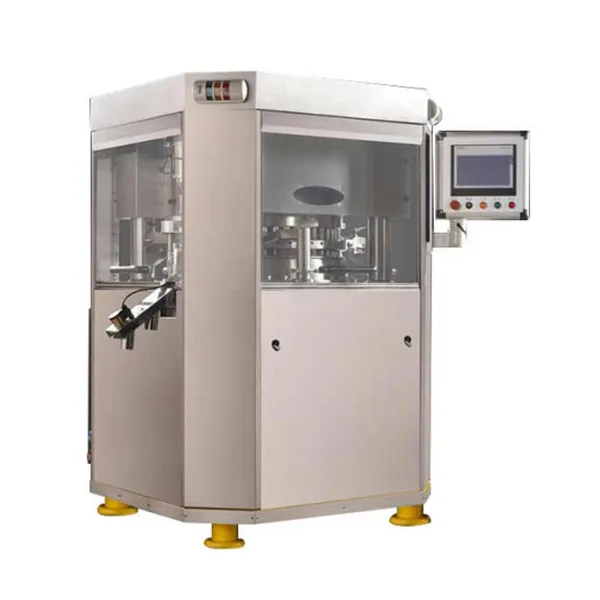
Consider a rotary tablet press as one possible unit operation within an oral-solid line. The photographed SED Pharma press below is a real equipment example; its presence does not imply that the whole line is flexible, nor that its advertised capacity is achievable for every formulation. The relevant capability is whether a specific product can be run in an approved configuration with reproducible quality. For a broader equipment context, the site's pharmaceutical machinery range is a useful starting point, while the rotary tablet press example shows one possible unit operation.
Process knowledge is the main source of flexibility
A rapid changeover is only useful if the new product's process window is understood. ICH Q8(R2) links pharmaceutical development to knowledge of the formulation, process and control strategy, and notes that stronger scientific understanding can support flexible regulatory approaches [2]. This does not grant blanket permission to move operating parameters freely. Product-specific approved ranges, change control and the applicable market authorization still govern what the site can do.
For each product, the production record should identify critical material attributes, relevant process parameters, quality attributes and the checks that detect drift. The purpose is not to collect every possible signal. It is to make the control logic explicit enough that operators and quality staff can distinguish an allowed adjustment from a change requiring investigation or approval. Data from earlier campaigns may inform later ones, but a transfer between products or scales still needs a scientific rationale.
Four operational pressures to evaluate
The table below translates the trend into questions a production and quality team can answer with site data. The rows are not acceptance limits; each facility should set its own measures based on products, regulatory commitments and risk assessment.
| Pressure | What to measure | Operational implication |
|---|---|---|
| More frequent campaigns | Setup, clearance, cleaning and first-off time per campaign | Reserve complete changeover windows before promising output. |
| Variable batch size | Qualified yield at the smallest and typical batch | Check whether startup loss dominates small runs. |
| More configurations | Recipe, tooling and component traceability | Make the approved configuration identifiable for every lot. |
| Demand shifts | Schedule adherence and inventory exposure | Compare added flexibility with planning and quality-review workload. |
Quality systems must travel with the configuration
Shorter campaigns can multiply record transitions. Recipe selection, electronic permissions, line-clearance evidence, batch reconciliation and deviation handling become more visible because there are more handoffs per month. A fast mechanical changeover that leaves ambiguous records is not an improvement. The operator should be able to identify exactly which approved configuration produced each lot, with traceability for materials, settings, checks and interventions.
FDA's process-validation guidance describes a lifecycle that includes process design, qualification and continued process verification [3]. Applied to a flexible line, this means a site should plan how each product and configuration is introduced, how performance is demonstrated, and how ongoing data will reveal drift. It does not mean that a single successful demonstration qualifies an unlimited set of products. The site's applicable GMP framework and approved submissions decide the formal evidence requirements.
Where flexibility stops being economical
More changeovers are not always better. A shared line may be a poor fit if cross-contamination controls become disproportionate, cleaning cycles consume most available time, or product-specific utilities and environmental needs conflict. Some products need dedicated equipment or segregated operations. Others can share a platform but still require separate validated recipes and tooling. The economic decision should include quality work, scheduling risk and inventory exposure rather than only machine utilization.
There is also a difference between making a line adaptable and making demand predictable. If forecast volatility drives frequent last-minute changes, a site may need stronger planning discipline before investing in hardware. Flexible equipment can reduce the cost of an approved change; it cannot remove the need for material readiness, release decisions or a stable control strategy. For separate treatment of project planning and procurement, see common production-line planning mistakes and equipment decisions for a production line.
A useful discussion before the next production cycle
The most productive starting point is a map of the actual campaign mix: products and strengths, typical and minimum batch sizes, changeover frequency, cleaning and hold times, quality-review delays, and qualified output per campaign. That evidence reveals whether the constraint sits in physical conversion, process understanding, documentation or release. It also gives an engineering partner a concrete basis for discussing possible modules without turning the conversation into a generic equipment list.
SED Pharma can review that operating profile alongside product and site constraints. Share the current campaign calendar, dosage forms, batch-size range, changeover records and main quality bottlenecks through the production requirements form. The discussion can then focus on which parts of the production line need adaptability and which controls must remain product-specific.
Conclusion
Flexible manufacturing matters because a pharmaceutical production line increasingly has to deliver consistent quality across changing campaigns, not merely run quickly during one stable campaign. The strongest case is built from measured changeover burden, qualified output and clear product-specific controls. Modularity may help, but process knowledge and the quality system determine whether that flexibility is usable.
Sources and further reading
[1] U.S. Food and Drug Administration (FDA). Focus Area: Advanced Manufacturing. https://www.fda.gov/science-research/focus-areas-regulatory-science-report/focus-area-advanced-manufacturing
[2] International Council for Harmonisation (ICH). Q8(R2) Pharmaceutical Development, 2009. https://database.ich.org/sites/default/files/Q8_R2_Guideline.pdf
[3] U.S. Food and Drug Administration (FDA). Process Validation: General Principles and Practices, 2011. https://www.fda.gov/regulatory-information/search-fda-guidance-documents/process-validation-general-principles-and-practices